Most of lockdown wasn’t great for training – home kata is quite difficult unless you’ve got a particularly spacious living room – but there were some upsides. Online training meant we could stay connected and keep training together, and it meant I could make time for yoga again, because my teacher started running classes online.
Yoga is great for karateka: it can improve your strength, flexibility and balance, help you recover from injuries (check with your physio before starting!) and improve your focus. You can choose from lots of different yoga classes, depending on what you’re looking for. Many classes are very westernised, while some try to focus on the roots of the practice.
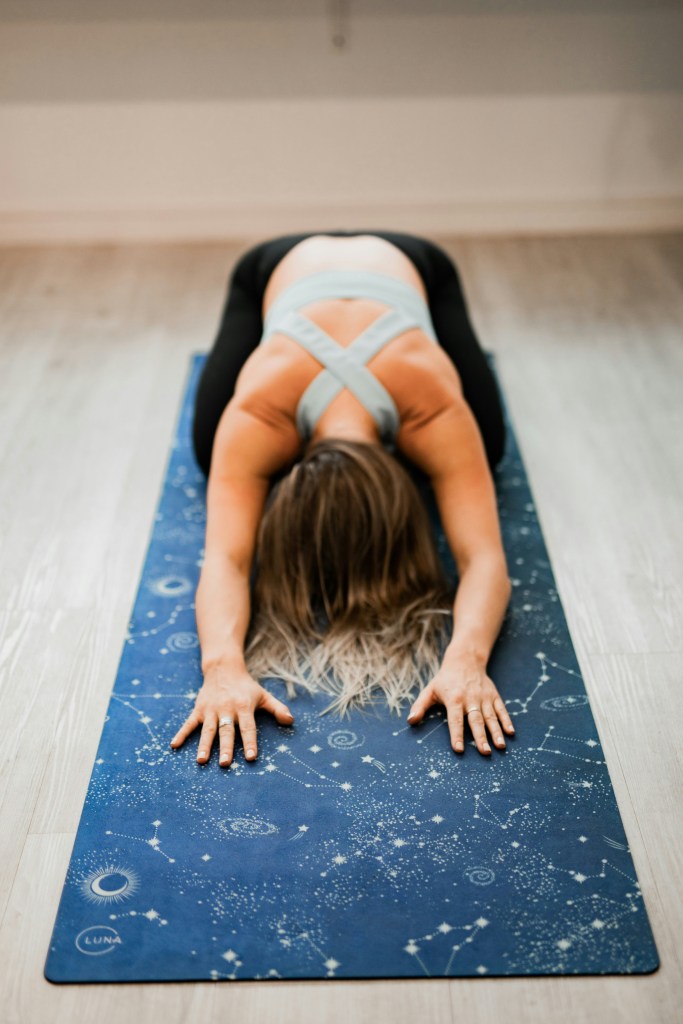
Photo by LUNA ACTIVE FITNESS on Unsplash
In his book about yin yoga, Bernie Clark explains:
Most forms of yoga today are dynamic, active practices designed to work only half of our body, the muscular half, the “yang” tissues. Yin Yoga allows us to work the other half, the deeper “yin” tissues of our ligaments, joints, deep fascial networks and even our bones. All our tissues are important and need to be exercised so that we can achieve optimal health and vitality.”
We also need balance. When you do a lot of strength and cardio training, and you live with a lot of stress, you need proper relaxation that actively rejuvenates you – unfortunately not just wine and crisps in front of the telly.
In a yin class, you get into the pose and find a gentle stetch. Then you use blocks, pillows and blankets to support yourself, so that you can focus completely on relaxing rather than trying to hold yourself in the right position. You then stay there for three minutes (it can be longer). Relaxing actually takes a lot of focus: I have to consciously let go of each part of my body, which has developed my awareness of just how much tension I’m accumulating in the week leading up to the class. The letting go isn’t just physical, it’s emotional, and the two aren’t separate: to let go physically we need to let go emotionally and vice versa.
On a good day, you can gradually move further into the stretch, trying to keep yourself in the mild discomfort zone and work your edge. It’s familiar ground for Zen students: as with meditation, you appear to be still, but actually you’re sitting with your discomfort and your wish for the time to just hurry up, then working with how that preference for things to be different occupies your mind and tenses your body.
If you’re a yin type and perpetual daydreamer like me, you’ll find the long poses suit you quite nicely, but that it’s far too easy to drift away and lose the benefit of the practice. Every time the minds skips off to think about say, a nice hot cup of tea, or starts scrolling through tomorrow’s to-do list, little tensions creep into the pose and you need to come back to being in your body so you can let them go again. If you’re more of a yang person, you might find the minutes pass more slowly than they do when you’re queuing for toilets or waiting for the London Underground.
Once your three minutes are up, you move into shivansana for a minute, lying flat on the floor to let your body readjust, or ‘rebound’, before heading into the next pose. Again, you need to keep focusing on your body and not say, cake or taking the bins out.
It’s great to do an evening yin class and go straight to bed. Doing it online, at home, makes that possible, though sometimes there can be interruptions to the relaxation. One session became more lively than intended when my cat spotted another class participant’s cat on the screen and followed his every move.
By the end of the class, so much tension has left your body that you’re ready for a sleep. Yin yoga is particularly suited to online classes, since there’s the option to go straight to bed as soon as you log off and, actually, yoga gear can sometimes look really like pyjamas.
Read more
The Martial Artist’s Book of Yoga – Lily Chou
The Complete Guide to Yin Yoga – Bernie Clark
Try a class
 Some other thoughts