
Yoga is a great complement to karate training. The combination of strengthening, stretching out and resetting your body, plus the focus on posture and alignment, makes for great hojo undo. But the time and the expense can be difficult to manage – and I’ve got a hectic schedule anyway.
I discovered the Down Dog yoga app last year, after looking at few alternatives. It’s a nice, clear interface, and you can choose both which model demonstrates the poses (though only two are available at the moment) and the voice that reads out the instructions (the one that sounds like Dame Judi Dench as M is my favourite). There’s music, but I switch that off as it interferes with my focus – which is often compromised anyway by deliveries, obstructive furniture and having to scoop the cat up from the end of my mat every so often. You can set the parameters for each session by picking a ‘type’ (including standard choices like hatha and vinyasa, as well as ‘Wake Up Yoga’ and Pilates), a level, how much instruction you get and how long you spend in each bit of the practice (like warm up and savasana). The ‘Boost’ and ‘Secondary Boost’ features, which let you choose emphases for your practice (like neck stretches or back strength), is useful when I particularly need to stretch out my dodgy hip and my push-up solidified shoulders. A real teacher’s input is probably important if you want to make significant progress, though: I thought my stiff hips were stopping me achieving half lotus, and the virtual teacher happily supplied fixes for that, but my human teacher pointed to my stiff quads.
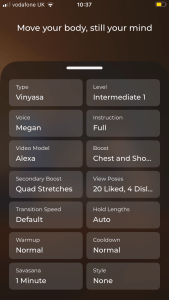
Once you’re into your practice, you can give poses the thumbs up or thumbs down – choose the former and you’ll get more of them in future sessions; choose the latter and they’ll be excluded from your practice. While that seems like a good move for dealing with injuries or poses that are out of reach for you, it’s probably not what a real teacher would do. A practice that’s just made up of a succession of things you like or find comfortable may stretch a few muscles but will not truly develop your body and mind in the comprehensive way a yoga practice intends. A real teacher would usually adapt the pose to something you can achieve, help you into the pose you think you can’t do or give you a preparatory exercise.
The ‘full instruction’ setting gives a lot less guidance than I’d expect – but that’s not a problem if you’re using it alongside at least occasional sessions with a real teacher. It’s also worth bearing in mind that the app doesn’t have the capacity to check you’re doing the poses properly, so there might be a significant risk of injury – or at least no progress – if you don’t have a fair bit of yoga experience. This is probably what’s said in the lengthy disclaimer you get shown when you start using the app, though I didn’t read it and I doubt anyone else will.
The only advantages of the app over real classes are the price – £58.99 a year (or more if you pay monthly) – and that you can choose the length of your practices to within five minutes, and do them whenever you like. But this is a false comparison: the app isn’t a replacement for a real teacher, but it is a really useful and incredibly convenient practice aid – a more sophisticated version of the posters and cards I used to use. It adds enough variety to help you avoid getting stuck in a rut with your own practice when you can’t get to classes, and helps to maintain your progress.
 Some other thoughts