Down Dog yoga app: a flexible practice aid

Yoga is a great complement to karate training. The combination of strengthening, stretching out and resetting your body, plus the focus on posture and alignment, makes for great hojo undo. But the time and the expense can be difficult to manage – and I’ve got a hectic schedule anyway. 

I discovered the Down Dog yoga app last year, after looking at few alternatives. It’s a nice, clear interface, and you can choose both which model demonstrates the poses (though only two are available at the moment) and the voice that reads out the instructions (the one that sounds like Dame Judi Dench as M is my favourite). There’s music, but I switch that off as it interferes with my focus – which is often compromised anyway by deliveries, obstructive furniture and having to scoop the cat up from the end of my mat every so often. You can set the parameters for each session by picking a ‘type’ (including standard choices like hatha and vinyasa, as well as ‘Wake Up Yoga’ and Pilates), a level, how much instruction you get and how long you spend in each bit of the practice (like warm up and savasana). The ‘Boost’ and ‘Secondary Boost’ features, which let you choose emphases for your practice (like neck stretches or back strength), is useful when I particularly need to stretch out my dodgy hip and my push-up solidified shoulders. A real teacher’s input is probably important if you want to make significant progress, though: I thought my stiff hips were stopping me achieving half lotus, and the virtual teacher happily supplied fixes for that, but my human teacher pointed to my stiff quads.
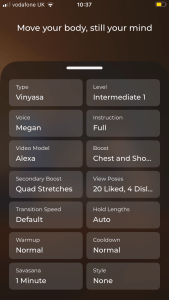
Once you’re into your practice, you can give poses the thumbs up or thumbs down – choose the former and you’ll get more of them in future sessions; choose the latter and they’ll be excluded from your practice. While that seems like a good move for dealing with injuries or poses that are out of reach for you, it’s probably not what a real teacher would do. A practice that’s just made up of a succession of things you like or find comfortable may stretch a few muscles but will not truly develop your body and mind in the comprehensive way a yoga practice intends. A real teacher would usually adapt the pose to something you can achieve, help you into the pose you think you can’t do or give you a preparatory exercise. 

The ‘full instruction’ setting gives a lot less guidance than I’d expect – but that’s not a problem if you’re using it alongside at least occasional sessions with a real teacher. It’s also worth bearing in mind that the app doesn’t have the capacity to check you’re doing the poses properly, so there might be a significant risk of injury – or at least no progress – if you don’t have a fair bit of yoga experience. This is probably what’s said in the lengthy disclaimer you get shown when you start using the app, though I didn’t read it and I doubt anyone else will. 

The only advantages of the app over real classes are the price – £58.99 a year (or more if you pay monthly) – and that you can choose the length of your practices to within five minutes, and do them whenever you like. But this is a false comparison: the app isn’t a replacement for a real teacher, but it is a really useful and incredibly convenient practice aid – a more sophisticated version of the posters and cards I used to use. It adds enough variety to help you avoid getting stuck in a rut with your own practice when you can’t get to classes, and helps to maintain your progress.
Yin yoga: relaxed maintenance

Most of lockdown wasn’t great for training – home kata is quite difficult unless you’ve got a particularly spacious living room – but there were some upsides. Online training meant we could stay connected and keep training together, and it meant I could make time for yoga again, because my teacher started running classes online.

Yoga is great for karateka: it can improve your strength, flexibility and balance, help you recover from injuries (check with your physio before starting!) and improve your focus. You can choose from lots of different yoga classes, depending on what you’re looking for. Many classes are very westernised, while some try to focus on the roots of the practice. 

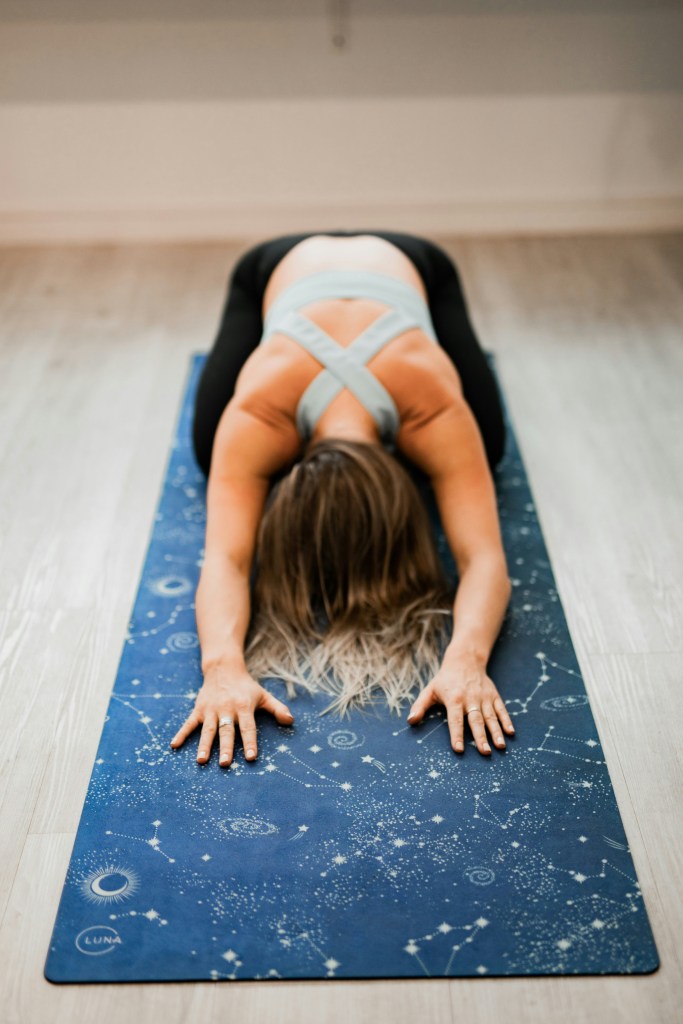
Photo by LUNA ACTIVE FITNESS on Unsplash

In his book about yin yoga, Bernie Clark explains:

Most forms of yoga today are dynamic, active practices designed to work only half of our body, the muscular half, the “yang” tissues. Yin Yoga allows us to work the other half, the deeper “yin” tissues of our ligaments, joints, deep fascial networks and even our bones. All our tissues are important and need to be exercised so that we can achieve optimal health and vitality.”

We also need balance. When you do a lot of strength and cardio training, and you live with a lot of stress, you need proper relaxation that actively rejuvenates you – unfortunately not just wine and crisps in front of the telly. 

In a yin class, you get into the pose and find a gentle stetch. Then you use blocks, pillows and blankets to support yourself, so that you can focus completely on relaxing rather than trying to hold yourself in the right position. You then stay there for three minutes (it can be longer). Relaxing actually takes a lot of focus: I have to consciously let go of each part of my body, which has developed my awareness of just how much tension I’m accumulating in the week leading up to the class. The letting go isn’t just physical, it’s emotional, and the two aren’t separate: to let go physically we need to let go emotionally and vice versa. 

On a good day, you can gradually move further into the stretch, trying to keep yourself in the mild discomfort zone and work your edge. It’s familiar ground for Zen students: as with meditation, you appear to be still, but actually you’re sitting with your discomfort and your wish for the time to just hurry up, then working with how that preference for things to be different occupies your mind and tenses your body. 

If you’re a yin type and perpetual daydreamer like me, you’ll find the long poses suit you quite nicely, but that it’s far too easy to drift away and lose the benefit of the practice. Every time the minds skips off to think about say, a nice hot cup of tea, or starts scrolling through tomorrow’s to-do list, little tensions creep into the pose and you need to come back to being in your body so you can let them go again. If you’re more of a yang person, you might find the minutes pass more slowly than they do when you’re queuing for toilets or waiting for the London Underground. 

Once your three minutes are up, you move into shivansana for a minute, lying flat on the floor to let your body readjust, or ‘rebound’, before heading into the next pose. Again, you need to keep focusing on your body and not say, cake or taking the bins out. 

It’s great to do an evening yin class and go straight to bed. Doing it online, at home, makes that possible, though sometimes there can be interruptions to the relaxation. One session became more lively than intended when my cat spotted another class participant’s cat on the screen and followed his every move. 

By the end of the class, so much tension has left your body that you’re ready for a sleep. Yin yoga is particularly suited to online classes, since there’s the option to go straight to bed as soon as you log off and, actually, yoga gear can sometimes look really like pyjamas.

Read more

The Martial Artist’s Book of Yoga – Lily Chou

The Complete Guide to Yin Yoga – Bernie Clark

Try a class

https://toniwolfyoga.com

My hojo undo: barre

I got into barre reluctantly, by accident. I’ve got two different hip problems and have been through a variety of physio and rehab, and missed a lot of training. I’ve also had a shoulder injury and I’m crap at push ups.

Ballet dancers’ feet

Photo by Jess Zoerb on Unsplash

I was talking to the physio I went to see for my shoulder about strength generally. I’d tried a few different things by that stage: exercises from the physio (often effective, but targeted and don’t address the whole body), reformer pilates (small, expensive classes, scary device that looks a bit Middle Ages), individual pilates instruction (really properly expensive, incredibly fancy gym, inconvenient location, but effective), group pilates (highly effective, but a long journey and complicated parking). He mentioned barre in passing, and I thought it was worth a try.

I found a Barrecore studio near me. I joined a queue of beautifully sculpted and lycra’d barre devotees in the fragrant basement of Sweaty Betty in Wimbledon. I felt a bit under dressed in my ancient gasshuku t-shirt and cheap leggings.

The class was in a carpeted, mirrored studio, with purple mats and pink weights. Many of the movements were familiar from the Pilates classes I’d been to, but Barrecore adds more bodyweight exercises and many variations on a plank. A lot of the movements are tiny but demand fierce endurance, like lengthy squats on the balls of your feet, standing splits and the full-body ‘ice skater’. 

The instructors move from wince-inducing micro-moves to careful stretches with a ballet dancer’s flowing grace, which is a wonderful thing to aspire to while I lurch from failed plank to flailing side plank. They’re great at explaining why you’re doing what you’re doing and how the movements work, including – and karateka will appreciate this more than their core audience – why we’re spending an agonising amount of time in shicodachi (or ‘wide second position’). It’s essential to get your posture right and make sure you do exactly as the instructor says; there’s even a ‘form’ class, which helps you get used to the moves, before moving into their usual ‘signature’ class. There’s also an advanced class.

I went to a few classes until I felt I’d got a good idea of what to do, then switched to the on-demand classes. For only £25 a month, you can watch as many of their videos as you like. You can choose a short workout to focus on one area of the body, or do the whole thing – I found the short lower body classes really helpful for keeping my hip injury in check for the run-up to my last grading. It’s probably a good idea to go to an in-person class every so often, just to check you’re doing things right, though there are plenty of reminders in the videos. 

You need to do a few videos a week to see results, and I struggled to find the time, but once I’d seen the improvement to my hip, my balance and my core strength, I was hooked. I wouldn’t go so far as to say I’m good at barre yet, and I can’t see anyone describing it as fun – in fact it’s right up there with parking in the entertainment stakes – but if you’ve got to the stage where you’re thinking about buying shares in your local physio practice, it’s a bargain.

Covid and back

My partner got covid first. It was quite snotty and sneezy, then she got the fever.

I lost my sense of taste and smell, and that was hard for me. They’re usually very strong: without covid, I have a love of exploring the perfume counter at every airport that drives my other half round the bend, a slightly off-piste tea tasting hobby and a trigger-happy gag reflex.

Then I got the fever, and then the breathlessness and dizziness. Just getting out of bed and going to the kitchen made me feel woozy and wheezy. Thinking I was on the mend one day, I called a friend. She said she could hear my breathlessness – I kept taking breaths mid-sentence. Sometimes it felt like my heart was working really hard, as if I’d just run for an unusually fast bus, even though I was lying in bed watching telly. I got dehydrated and had to drink lots of water. 

Training was out of the question. As the illness eased up, my temperature started going up and down, then the general trend was down. The breathlessness and dizziness lasted a while, but mainly I felt flattened by exhaustion; I kept needing to go back to bed for a nap. 

It was really helpful to get messages from other people who’d had it, urging me to take things slowly and reminding me that recovery took a while. Hearing that, after the first couple of weeks of feeling dreadful, they’d needed a couple of months to recover properly made me set realistic expectations and reassured me that it would pass. I’d also seen MD in Private Eye – a great source of sensible information and opinion during the pandemic – recommend taking plenty of rest and time to get back to normal.

When I was a teenager, I had glandular fever followed by chronic fatigue. At the time, the advice was to manage it by doing an hour of your normal activity (school work, not hard training!) then taking an hour’s rest – a way of pacing yourself. I remembered that and started doing it. I find it really hard to sleep during the day, but just lying down and resting was enough. I noticed that the exhaustion made my body feel quite tense, and relaxing more intentionally really helped. In his totally amazing book The Essence of Shaolin White Crane, Dr Yang, Jwing-Ming describes a meditation practice you can do lying down – it’s fine to fall asleep, he says, and can be beneficial. A meditation practice also helps you deal with the kind of thoughts that prevent proper rest, like ‘Did I lock the back door?’, ‘Can I justify another Thai delivery – of course I can I’m ill – what shall I have…’ and ‘Will I be able to get my gi on after all these deliveries?’.

My first post-covid activity was yin yoga, which involves gentle stretches held for a couple of minutes to help the body relax and recover. I also did restorative yoga and yoga nidra, both of which are also aimed at relaxation and physical recovery. These practices are gentle, but still work with the body, so a few, well-spaced sessions were plenty to begin with. I also went back to qigong classes, which I started on Zoom last year and absolutely love.

Feeling much better one day, I did an hour of my usual, more intense yoga session, but was shattered the next day, and could hardly do anything. I took the lesson to heart, rested, and wrote a plan for getting back to my normal training regime. Most days I do a bit of my usual karate or yoga class, then stop, and I’m gradually adding more time each week. It seems to be working so far. Other people have recovered by doing the whole karate session, but gently, and ‘walking through it’.

The most important aspect of recovery from illness or injury is keeping in touch with your body. That sounds easy – we live in the thing don’t we? – but we often veto what the body needs with our own ideas about what we should be doing, whether that’s forcing ourselves to keep going when we shouldn’t or sitting in front of the telly instead of training. There’s also the fear of damaging yourself more. Am I breathless because I have covid, or because I’m worried about covid? Do I need to rest because I’m tired because of covid, or am I just tired because I’m… tired?

Illness and injury are part of training: they force you to learn more about finding a balance between rest and activity. Managing frustration at not being able to do much is also part of this – you have to develop patience, which is essential to developing anything else.

There’s an NHS website dedicated to helping people recover after covid. Do talk to your GP if you’re worried.

Gambatte!