Costa Coffee, Balham

Traffic grinds along; clattering busses and groaning motorbikes. The first schoolkids have started to walk past, some neat in new uniforms and some with saggy blazers and untucked shirts. There’s a general increase in pedestrian traffic, all wandering past the tables not quite lined up outside the coffee shop. It’s in a big street in a relatively wealthy area, yet has the transitory feel of a mainline station on a Sunday evening, when the trains are sparse or cancelled. The raggedy outside of the café, with its tumbleweed litter and scrolling loners, contrasts to the bright and neat interior with its chatty staff.

A lady with neon pink hair and double denim wanders up to me. ‘Have you got another pound?’ she asks.

‘Sorry,’ I say.

‘I’ll have to have some water before I go,’ she continues, patting her stomach. ‘I might go to the bank tomorrow. I’ve seen some leggings that I like.’

I smile, I have no idea what to say. Eventually, I settle on ‘I hope that goes okay’. She turns round and heads into the café.

A couple sit next to me, plonking down one espresso between them, then quickly evaporate. Children congregate in huddles at the bus stop and smaller knots outside the supermarket, emerging with plastic-wrapped snacks. The mint tea I ordered is now thoroughly steeped, and is destined to be more so since our conversationalist has now been replaced by an over-friendly wasp, whose attentions continue for some considerable

(wasp)

The tea is served as a bag in a tall glass mug with a fiddly handle accompanied by a pot of hot water that looks small, but makes a few cups. If this were at home, a co-habitee might make remarks about creating unnecessary washing up or

(wasp)

It’s particularly interested in my handbag, though there’s no sugar and it’s

(wasp)

The tea is kind of indeterminate. It has a mint flavour, but it’s like the mint flavour that comes with toothpaste or chewing gum, a sort of breath freshener and cooler rather than something that involves food or drink. There’s a lot of it, which is fine by me, but eventually the air starts to get chilly. The kids have long gone home, the fellow scrollers have moved on and even the wasp has packed up for the day, so I’m off too.

Lockdown Omelette: a vague recipe

My mother’s Crap Pie is the stuff of legend. In fact, it’s so legendary that I’ve started to doubt whether it actually existed.

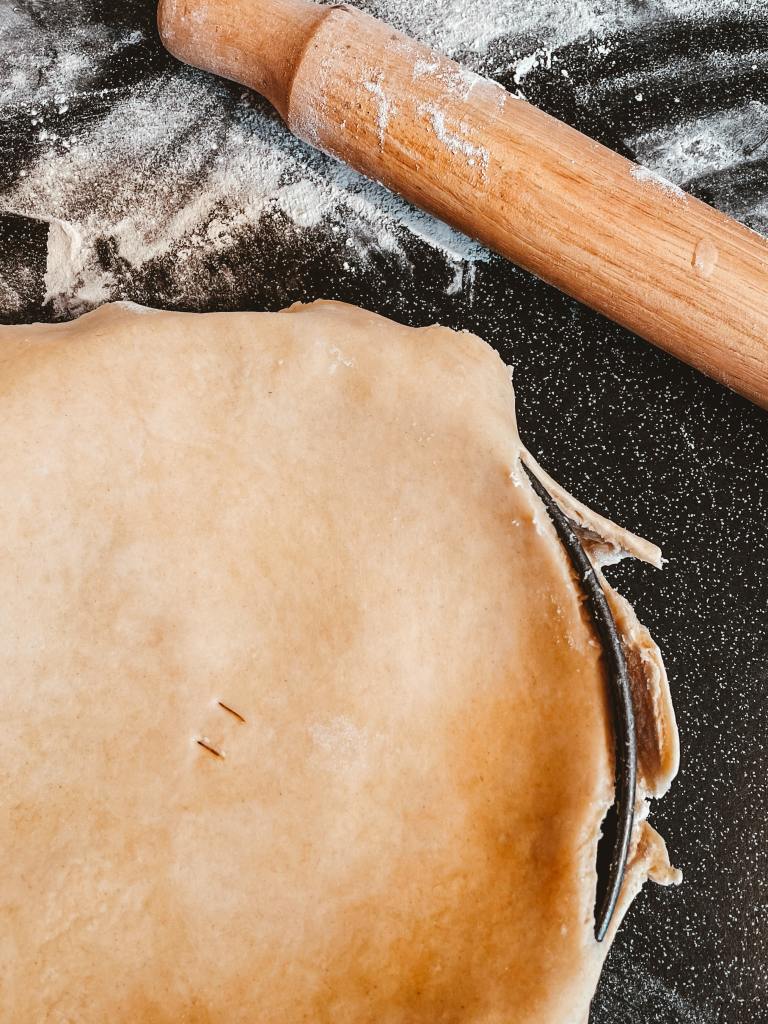
The idea was that, since small children leave a lot of their food, it would be economical – these days, perhaps, zero waste – to save the scraps and do something with them. Thus the scraps were gathered and when sufficient were to hand – so the legend goes – they were tipped into a dish, coated with a pie crust and served up to those who hadn’t deigned to finish them first time round.

Photo by Hello I’m Nik on Unsplash

The evidence for this phenomenon is weak: composite, procedural memories of pies and pie dishes on the table at home; a vague sense that mince and baked beans go really well together; and occasional, snarky mentions during Christmas dinner.

The Lockdown Omelette arose out of some unusually large vegetables and a new egg buying procedure, during the first lockdown in 2020. We and a neighbour had found catering suppliers who only offered eggs in very large trays. We’d also scored some truly magnificent veg boxes diverted from closed restaurants, from New Covent Garden Market. The boxes were incredible – the veg was perfect, and I’ve never seen onions that big – but each selection was huge and I struggled to use them up. I created the Lockdown Omelette.

Photo by Erol Ahmed on Unsplash

It’s great for me, since I’m dreadful at following recipes and don’t like making anything apart from tea the same way twice, so the only consistent ingredient is the eggs.

1. Fry up your veg in a sauté pan. I usually start with onions and cook them slowly, with the lid on, and if I’m using peppers I cook them at the same time for sweetness. Then I add other veg.

2. While that’s happening, beat six or more eggs. Sometimes I add stuff like harissa to the eggs. Cream is also a nice touch.

3. Add the eggs and stir in a vague and unfocussed way to ensure relatively even distribution.

4. Allow to cook on a low heat, until it looks like the bottom half has solidified sufficiently. While this is happening, grate some cheese (optional: sometimes it really isn’t a cheese day) and switch on the grill.

5. Pop the pan under the grill (I’ve left it until now to tell you a pan with a plastic handle isn’t a good plan).

6. When it’s looking sort-of ungooey on top, take the pan out and sprinkle the cheese on top.

7. Return the pan to the grill and wait until the cheese reaches your preferred meltiness.

Lockdown Omelette is probably nice with things like pepperoni, ham and chorizo but I don’t eat those. Maybe it should be called a tortilla, but isn’t that to do with potatoes? Ask a serious chef; I don’t know stuff like that.

Some Nice Combinations

I’m not very good at remembering what I put in, but I think these were quite good.

  • Onions, capers, olives and tomatoes.
  • Onions, sweet red pepper, grated courgette, cheese.
  • Onions, capers, peas and courgettes (The Wife made this one).
  • Onions, harissa, red and yellow peppers, spinach.

Actually, these all have onions. Maybe I should have specified onions more specifically above. Created your own? I’d love to hear about your Nice Combinations.

Breakfast tea(s) on Wimbledon Common

The early morning outside Wimbledon Tearooms is like the early morning on a campsite: general drowsiness, carping birds and a sharp retort of fresh air. ‘It’s nice,’ says the lady at the next table, contemplating a brownie, ‘But not Richmond Park nice’. Two teenagers slouch at the table next to her and the three discuss the virtues of cakes like red velvet, carrot and lemon drizzle.

Like me, most of the people here look as if they’re still waking up, but the dogs are straining on their leads, enthusiastic about everything. A border collie watches, tongue out, as food and drink is distributed to a toddler, and a spaniel makes a break for freedom, nearly towing its owner under a table.

There are lots of paper cups with various fillings, and the odd frankly magnificent-looking white bread sandwich with glorious, artery-hardening contents. The muted morning conversation is interrupted every so often by staff announcing the production of the next order to a pacing herd of people eager for caffeine.

Having already jolted myself semi-awake with a bucket of neat black coffee, mine today is a peppermint tea. The bag is having a thorough soak. I’m feeling dreadful after my second covid jab and, on no medical evidence, have a blind faith in peppermint tea’s ability to calm things down. The tea is both warm and menthol-cool, but it lacks caffeine kick a person needs at this time of day.

Runners slouch past. A man is patiently explaining to two little people that we start the day with Shreddies, not chips. There are protests, then a little voice starts repeating ‘Here comes the train’ and down each spoonful goes.

Having finished the peppermint tea, I order an English Breakfast tea. Waiting for it with the pacers, I admire the dogs. One large brown and white specimen gazes adoringly at a distracted-looking owner – or maybe at the extra sausage the owner has just collected. A Labrador patiently fiddles with its lead while its ears are fondled during a particularly gripping conversation. Something bashful hides between two table occupants, shaking slightly and looking out at other dogs. Something curly haired and defiant stands on a table still as a statue, ignored by guzzling owners.

My tea has ‘soya’ written on the lid in neat blue biro. The brand on the tag is ‘Birchall’, which I’ve never heard of, but there’s one of those ‘Great Taste’ badges. It makes a nice, thick, malty brew, but sits in the mid range, lacking discernible bass or treble. The soya’s good, not breaking up or too rich. It’s a decent sized cup, not insanely tall, though large enough to thoroughly recharge the batteries. But I think the complete experience requires one of those white bread artery hardeners. And maybe a dog.

Covid and back

My partner got covid first. It was quite snotty and sneezy, then she got the fever.

I lost my sense of taste and smell, and that was hard for me. They’re usually very strong: without covid, I have a love of exploring the perfume counter at every airport that drives my other half round the bend, a slightly off-piste tea tasting hobby and a trigger-happy gag reflex.

Then I got the fever, and then the breathlessness and dizziness. Just getting out of bed and going to the kitchen made me feel woozy and wheezy. Thinking I was on the mend one day, I called a friend. She said she could hear my breathlessness – I kept taking breaths mid-sentence. Sometimes it felt like my heart was working really hard, as if I’d just run for an unusually fast bus, even though I was lying in bed watching telly. I got dehydrated and had to drink lots of water. 

Training was out of the question. As the illness eased up, my temperature started going up and down, then the general trend was down. The breathlessness and dizziness lasted a while, but mainly I felt flattened by exhaustion; I kept needing to go back to bed for a nap. 

It was really helpful to get messages from other people who’d had it, urging me to take things slowly and reminding me that recovery took a while. Hearing that, after the first couple of weeks of feeling dreadful, they’d needed a couple of months to recover properly made me set realistic expectations and reassured me that it would pass. I’d also seen MD in Private Eye – a great source of sensible information and opinion during the pandemic – recommend taking plenty of rest and time to get back to normal.

When I was a teenager, I had glandular fever followed by chronic fatigue. At the time, the advice was to manage it by doing an hour of your normal activity (school work, not hard training!) then taking an hour’s rest – a way of pacing yourself. I remembered that and started doing it. I find it really hard to sleep during the day, but just lying down and resting was enough. I noticed that the exhaustion made my body feel quite tense, and relaxing more intentionally really helped. In his totally amazing book The Essence of Shaolin White Crane, Dr Yang, Jwing-Ming describes a meditation practice you can do lying down – it’s fine to fall asleep, he says, and can be beneficial. A meditation practice also helps you deal with the kind of thoughts that prevent proper rest, like ‘Did I lock the back door?’, ‘Can I justify another Thai delivery – of course I can I’m ill – what shall I have…’ and ‘Will I be able to get my gi on after all these deliveries?’.

My first post-covid activity was yin yoga, which involves gentle stretches held for a couple of minutes to help the body relax and recover. I also did restorative yoga and yoga nidra, both of which are also aimed at relaxation and physical recovery. These practices are gentle, but still work with the body, so a few, well-spaced sessions were plenty to begin with. I also went back to qigong classes, which I started on Zoom last year and absolutely love.

Feeling much better one day, I did an hour of my usual, more intense yoga session, but was shattered the next day, and could hardly do anything. I took the lesson to heart, rested, and wrote a plan for getting back to my normal training regime. Most days I do a bit of my usual karate or yoga class, then stop, and I’m gradually adding more time each week. It seems to be working so far. Other people have recovered by doing the whole karate session, but gently, and ‘walking through it’.

The most important aspect of recovery from illness or injury is keeping in touch with your body. That sounds easy – we live in the thing don’t we? – but we often veto what the body needs with our own ideas about what we should be doing, whether that’s forcing ourselves to keep going when we shouldn’t or sitting in front of the telly instead of training. There’s also the fear of damaging yourself more. Am I breathless because I have covid, or because I’m worried about covid? Do I need to rest because I’m tired because of covid, or am I just tired because I’m… tired?

Illness and injury are part of training: they force you to learn more about finding a balance between rest and activity. Managing frustration at not being able to do much is also part of this – you have to develop patience, which is essential to developing anything else.

There’s an NHS website dedicated to helping people recover after covid. Do talk to your GP if you’re worried.

Gambatte!
Love (Tea)

Last week I walked out of King’s Cross station with my daughter. As we turned on to Euston Road, I told her about the time I nearly missed the Sleeper I’d booked to visit my grandmother in Aberdeen because I went to King’s Cross instead of Euston. I had to run down the road carrying a huge rucksack to get there in time. I told my daughter how I used to visit my grandmother for her birthday in January every year, and how much I loved taking the train overnight. It made me think of Love Tea, so I bought it again today.

Image: https://www.pukkaherbs.com/uk/en/products/organic-teas.html

I loved the idea of Love Tea as soon as I saw it advertised and went straight out and bought it. In retrospect it seems odd to associate herbal tea with romance – in fact anything non-alcoholic seems a bit of a stretch – but that was what I was expecting when I bought it. I got something else entirely.

I explain what we’re testing to The Wife. She inspects the box. ‘Hang on,’ she says, ‘I’ve got to put my glasses on because the writing’s too small.’ A small pause while these are retrieved. ‘Seems to have all girls all over it, there are only two boys down the bottom. It reminds me of that thing…’ Eh?

‘It was on TV in the seventies and eighties, I can’t remember, maybe a Bond movie? There’s always dancing girls in Bond. It went doo-doo-doo… I can’t remember. Anyway, it looks like that.’ She starts trying to work out which are boys and which are girls from the bottom shape. It’s probably time to brew up.

The box suggests infusing for up to fifteen minutes, but our tea looks pretty substantial after five minutes, so I withdraw the bag. I hand The Wife hers, in a mug with a faded Shuri Castle print.

‘I never think fruit tea has a good colour. This one looks like wee. It does!’ She sips and giggles. ‘It’s ‘cos I always look at wee ‘cos I have to. As an athlete. Maybe it’s the mug…’

‘Taste-wise, I do taste quite a lot of lavender and was that because I read that there was a lot of lavender in it, or because it tastes of lavender? Is that rose in there? Maybe we need to dunk the teabag for a bit longer to get another flavour in there. Hmm…’ She sighs, contemplatively.

She continues: ‘I hope this isn’t like the valerian and it makes you sleep and I don’t wake up in the morning.’ She makes hand gestures conveying uncertainty. ‘A bit odd.’ She puts the cup down, picks up her tape measure and goes back to visualising furniture. ‘Yeah,’ she says from over by the telly. ‘Strange taste I think… Have you tasted it?… Oh, this is annoying me now. What is the name of that thing on TV?’

It smells like health food shops. Not Planet Organic or any other modern place: I mean the ones from the eighties, when eating tofu was a bit niche and only done by people in tie dye everything who wore socks and sandals (shockingly, even the latter is fashionable now) – and my granny. Long before it was fashionable, she was a strong believer in organic, holistic wholemeal everything, but also believed that this should be served with butter, cream and full-fat milk – none of your low-fat margarine nonsense. There was a particular vegan paté she favoured; her home-made muesli; dandelion coffee; and robust, grainy bread – plus apparently healthy yet wildly sugary biscuits. In the mornings she made me buttery egg on sturdy toast and set it down on a perfectly laid table, where it was dwarfed by heavy silver cutlery. In the evening she gave me ‘Night time tea’ from a box with a teddy bear in pyjamas on it. Love Tea tastes like her kitchen smelled. It doesn’t taste like any of the things that it’s made of; it smells of dark and heavy Victorian furniture, a sort of musty dustiness with depth. It’s smooth and strangely soothing.

The Wife is still researching the box. ‘Oh was it Roald Dahl? No…’ She supplies me with wine, for romance, still pondering. ‘Tales of the Unexpected!’ she announces, triumphantly. ‘That’s what it was!’ We finish the tea and I start the wine, watching the intro sequence on YouTube.

Having a Brew

Today is an in between day. Drizzling, but half-heartedly. Not actually cold, but you’ll need a coat. It isn’t the kind of weather that requires the kind of dark, thick, muscular brew that gets an army marching, but nor is it a pale Earl Grey day. Brew Tea’s 1940s-style packaging suggests marching tea, but then hints at more complexity, with florid descriptions of flavour and even suggestions for food pairings. Intriguing.

Brew Tea package

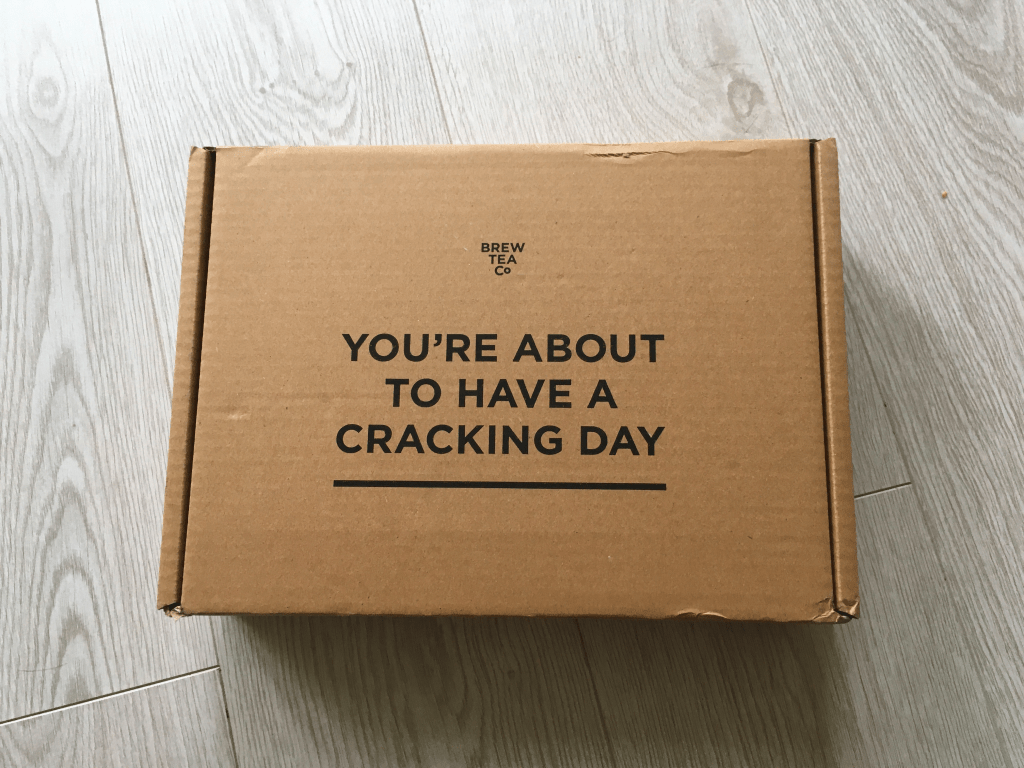
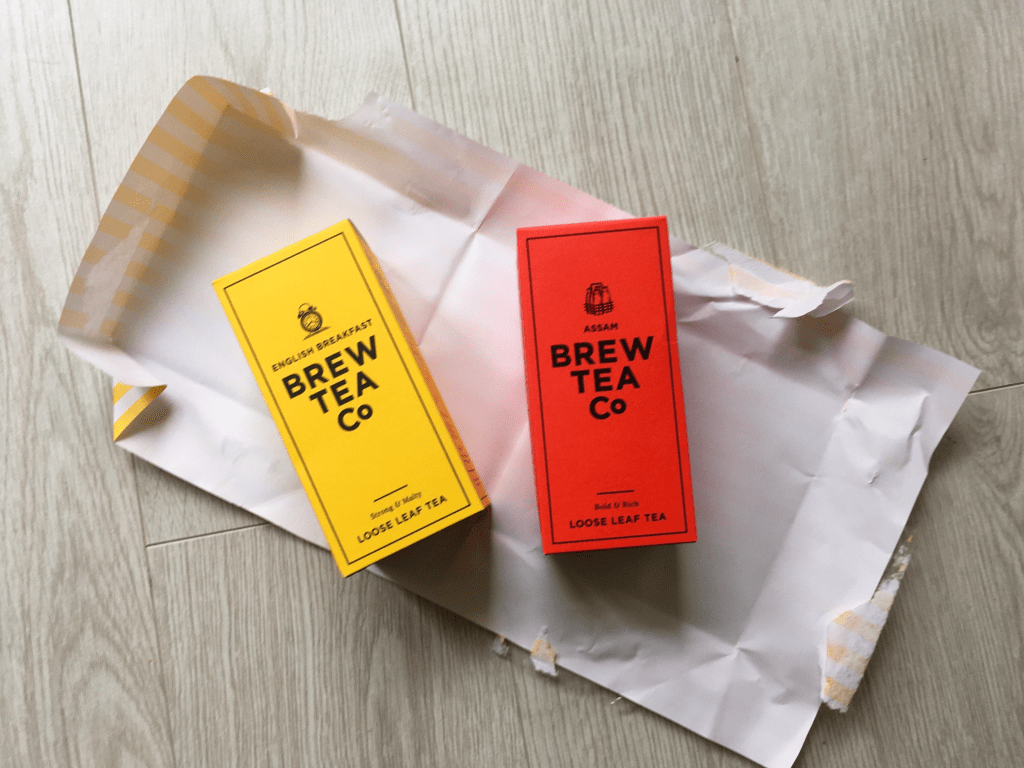
The tea arrives stylishly in a slogan-decorated box which, when dismantled, yields a lovely stripy present: gift wrapped Assam and English Breakfast. It’s a lovely idea for an actual gift, but perhaps more packaging than I’d like for our standard consumption, which could probably keep said army hydrated, if not necessarily marching.

There were two cards inside the box: a recycling guide and a ‘What to do while you brew’ card, with a game on it. The recycling guide is handy: it says that though the bag is compostable, it can ‘take a while to compost at home’. I’ve used compostable plastic-look packaging before – and found that it wasn’t. The Wife ended up having to fish it out of the compost bin while trying not to get a handful of worms or slimy peelings. I had an incident with a slug.

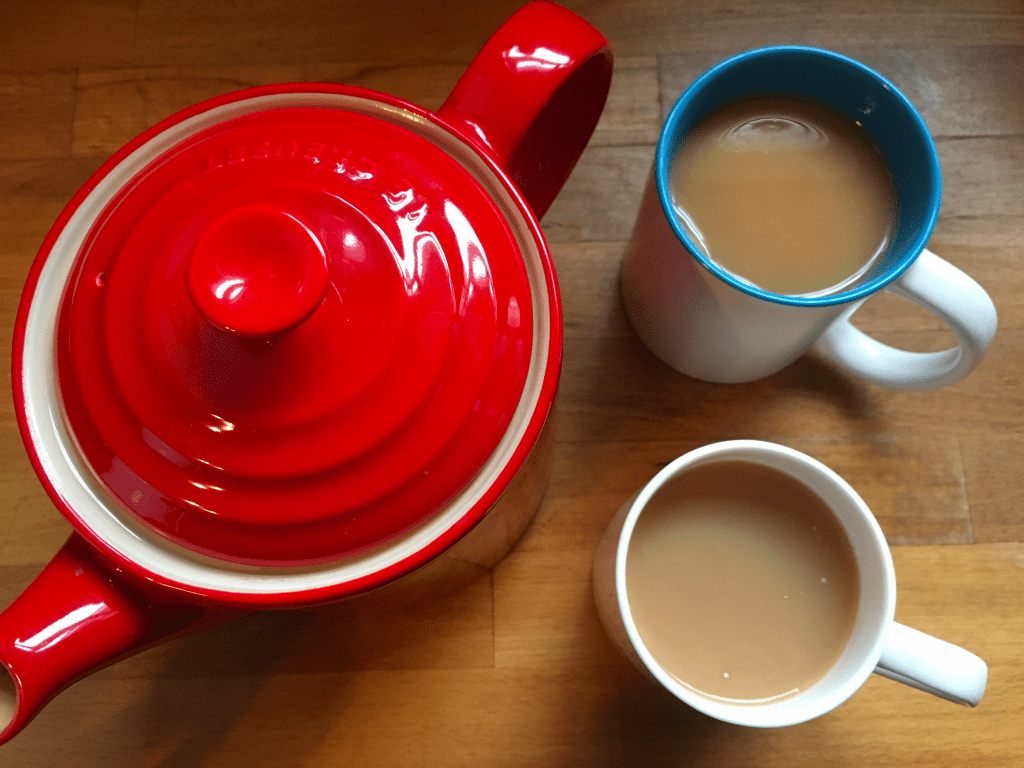
I brew the English Breakfast in my favourite teapot. The leaves obligingly expand on application of the water and the smell is just what we’re looking for – somewhere between warm oven and autumn walk. I pour it out – mine with oat milk, and The Wife’s with standard full-fat dairy. It looks a bit pale to me, maybe even a bit watery. Did I put enough leaves in the pot? Never mind; we can always brew a stronger one later. Here goes.

‘Quite a sturdy colour,’ The Wife says, on receiving her cup (a bone china number with a Quentin Blake illustration). There’s a pause while she spills some and dabs at her jeans. ‘Quite a welcoming tea smell,’ she continues. ‘Slightly overmilked’ (she can do her second cup herself, then). I’m quite impressed with mine. It doesn’t look as strong as our usual stuff, but it’s actually nicely malty, quite flavourful and has a pleasant astringency.

The Wife sips again. ‘Very subtle taste.’ Another sip, more dabbing, a quick trip into the kitchen for a cloth. ‘It’s the kind of tea you can drink gallons of without feeling over tea’d.’ She heads off to assemble her second cup, avoiding ‘overmilking’. ‘It’s one of those teas you feel like if you have a quick cuppa, you’ve had some light refreshment – rather than a strong brew where you feel like you need a biscuit with it.’

My father is quite specific on the subject of tea and biscuits, opining that a ‘naked drink’ is a horror on a par with ‘insubstantial marmalade’ (the stuff with thin peel, he explains, that you get in environmental time bomb containers, in hotels). He reliably produces Tunnock’s Teacakes, Abernethy biscuits or similar on all tea occasions.

On that note, I draw The Wife’s attention to the box, which suggests pairing this drink with food. It tells us that ‘A really good milk chocolate brings out the sweeter caramel notes.’ I rifle through the cupboards. The only milk chocolate I can find is St Petersburg souvenir chocolate, a fetching purple box of pieces individually wrapped in jolly illustrations of the city. We have to abandon this quite quickly, since the chocolate had, in The Wife’s words, ‘had its chips’ and we had perhaps carelessly allowed it to melt and reform on our journey home from the friend who supplied it. ‘Was there really no other chocolate in the cupboard?’ she says, with a furrowed brow. She finishes her cup and heads to the shops.