Down Dog yoga app: a flexible practice aid

Yoga is a great complement to karate training. The combination of strengthening, stretching out and resetting your body, plus the focus on posture and alignment, makes for great hojo undo. But the time and the expense can be difficult to manage – and I’ve got a hectic schedule anyway. 

I discovered the Down Dog yoga app last year, after looking at few alternatives. It’s a nice, clear interface, and you can choose both which model demonstrates the poses (though only two are available at the moment) and the voice that reads out the instructions (the one that sounds like Dame Judi Dench as M is my favourite). There’s music, but I switch that off as it interferes with my focus – which is often compromised anyway by deliveries, obstructive furniture and having to scoop the cat up from the end of my mat every so often. You can set the parameters for each session by picking a ‘type’ (including standard choices like hatha and vinyasa, as well as ‘Wake Up Yoga’ and Pilates), a level, how much instruction you get and how long you spend in each bit of the practice (like warm up and savasana). The ‘Boost’ and ‘Secondary Boost’ features, which let you choose emphases for your practice (like neck stretches or back strength), is useful when I particularly need to stretch out my dodgy hip and my push-up solidified shoulders. A real teacher’s input is probably important if you want to make significant progress, though: I thought my stiff hips were stopping me achieving half lotus, and the virtual teacher happily supplied fixes for that, but my human teacher pointed to my stiff quads.
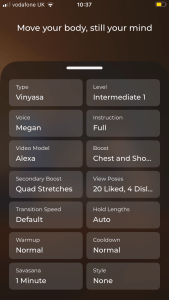
Once you’re into your practice, you can give poses the thumbs up or thumbs down – choose the former and you’ll get more of them in future sessions; choose the latter and they’ll be excluded from your practice. While that seems like a good move for dealing with injuries or poses that are out of reach for you, it’s probably not what a real teacher would do. A practice that’s just made up of a succession of things you like or find comfortable may stretch a few muscles but will not truly develop your body and mind in the comprehensive way a yoga practice intends. A real teacher would usually adapt the pose to something you can achieve, help you into the pose you think you can’t do or give you a preparatory exercise. 

The ‘full instruction’ setting gives a lot less guidance than I’d expect – but that’s not a problem if you’re using it alongside at least occasional sessions with a real teacher. It’s also worth bearing in mind that the app doesn’t have the capacity to check you’re doing the poses properly, so there might be a significant risk of injury – or at least no progress – if you don’t have a fair bit of yoga experience. This is probably what’s said in the lengthy disclaimer you get shown when you start using the app, though I didn’t read it and I doubt anyone else will. 

The only advantages of the app over real classes are the price – £58.99 a year (or more if you pay monthly) – and that you can choose the length of your practices to within five minutes, and do them whenever you like. But this is a false comparison: the app isn’t a replacement for a real teacher, but it is a really useful and incredibly convenient practice aid – a more sophisticated version of the posters and cards I used to use. It adds enough variety to help you avoid getting stuck in a rut with your own practice when you can’t get to classes, and helps to maintain your progress.
Joy Tea: Pukka teas

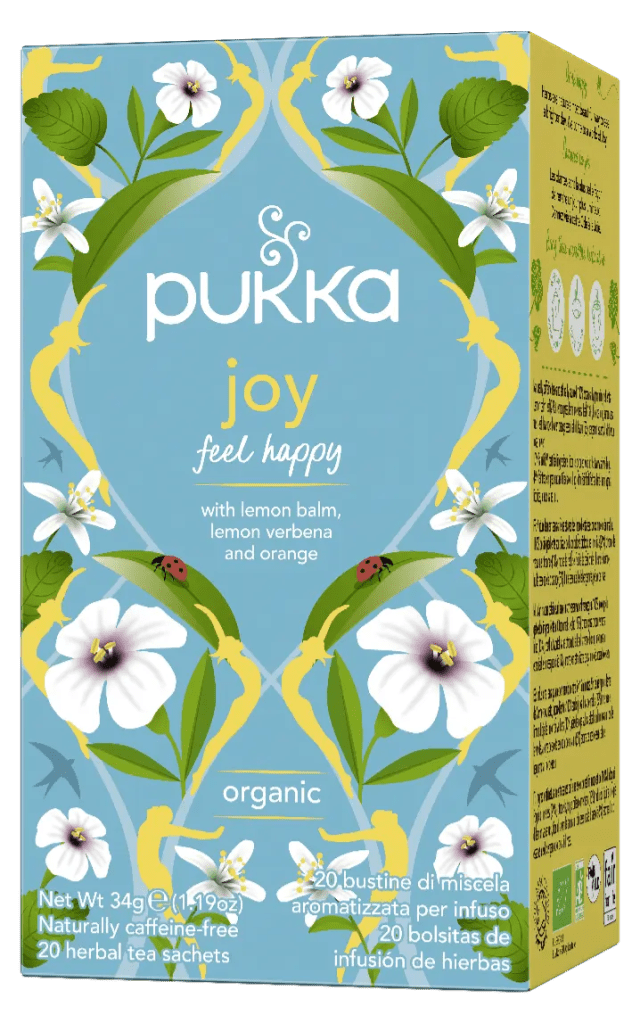
Joy Tea is part of a range of Pukka teas and a general wellbeing fad for providing emotional sustenance through herbal teas, usually with a self-care undertone. While taste and smell are always evocative, I’d hesitate to agree that herbal tea could meet my emotional needs in the same way that a stiff black coffee can turf me out of bed in the mornings. As Nina Stibbe says, ‘Coffee is not a drink… it’s not a drink like tea is a drink. Coffee is a drug. It’s just like having a cigarette or pill…’* Look, I enjoy herbal tea, really I do, but to suggest that at least the supermarket-level retail version has any psychoactive properties seems to be stretching it a bit. 

Image: https://www.pukkaherbs.com/uk/en/products/joy-tea

I picked up this particular variety while shopping for the final ingredients for Christmas dinner at a huge Tesco Extra, one of life’s less joyful experiences. My other half was hell bent on finding some ready-made stewed red cabbage, and I wasn’t sure that red cabbage was actually a proper part of Christmas dinner, so I started to flag quite quickly after seeking it out in the vegetable section, the ready meal section and eventually the freezer section. The endless patience required for the red cabbage quest plus the need to choose between a massive number of essentially the same beans meant we were starting to get fractious when we got to the tea aisle, so the choice of wellness option seemed obvious, as did grabbing something fast and fighting our way to the checkout as quickly as we could. 

Once brewed, Joy Tea is a golden caramel colour and smells somewhere between dusty potpourri and the orange creams neither of us like in a box of chocolates. But the flavour is a lot more exciting. Many herbal teas tend to be a bit bland, flavour wise, or they smell of bath oil and taste of nothing. This one tastes like high-end neroli perfume smells – both floral and fruity, both fresh and warm – with a thickness that makes it feel quite substantial. Joy is still a bit of a stretch, but this tea genuinely brings some sunny cheer into a cold afternoon, and it’s warming enough for a blustery day. I just wish it would stop reminding me of shopping for red cabbage.

* In Went to London, Took the Dog

Album review: Mogwai – The Bad Fire

Album review in Joyzine.

Book review: A Thousand Threads by Neneh Cherry

Book review in Joyzine.

B.A. Johnston + Schande at The Cavendish Arms, London

Live band review in Joyzine.

Yin yoga: relaxed maintenance

Most of lockdown wasn’t great for training – home kata is quite difficult unless you’ve got a particularly spacious living room – but there were some upsides. Online training meant we could stay connected and keep training together, and it meant I could make time for yoga again, because my teacher started running classes online.

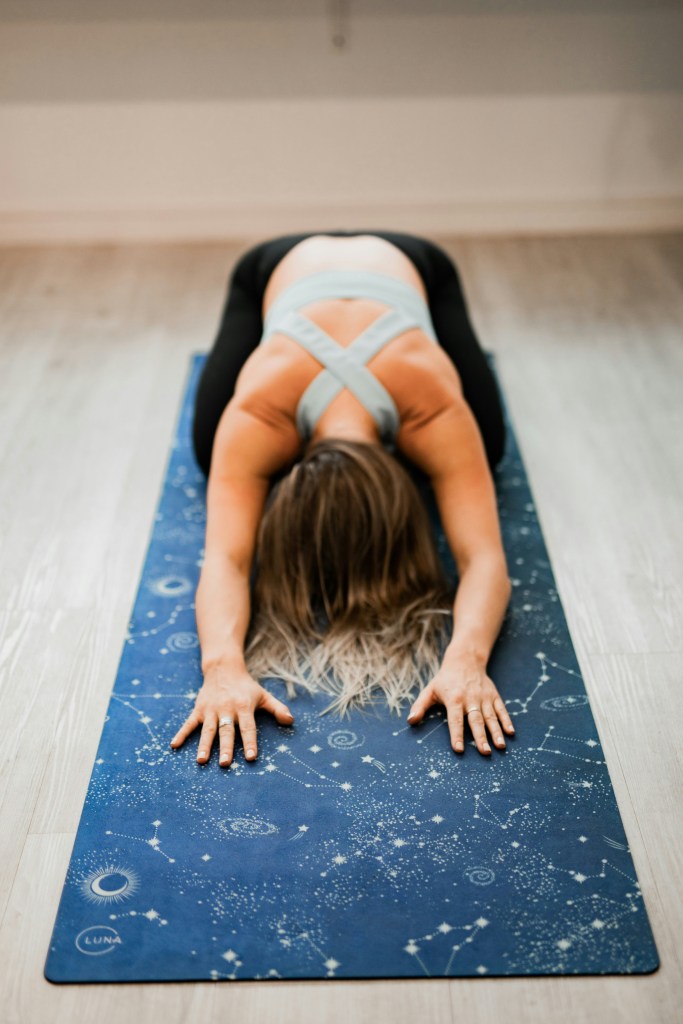
Yoga is great for karateka: it can improve your strength, flexibility and balance, help you recover from injuries (check with your physio before starting!) and improve your focus. You can choose from lots of different yoga classes, depending on what you’re looking for. Many classes are very westernised, while some try to focus on the roots of the practice. 

Photo by LUNA ACTIVE FITNESS on Unsplash

In his book about yin yoga, Bernie Clark explains:

Most forms of yoga today are dynamic, active practices designed to work only half of our body, the muscular half, the “yang” tissues. Yin Yoga allows us to work the other half, the deeper “yin” tissues of our ligaments, joints, deep fascial networks and even our bones. All our tissues are important and need to be exercised so that we can achieve optimal health and vitality.”

We also need balance. When you do a lot of strength and cardio training, and you live with a lot of stress, you need proper relaxation that actively rejuvenates you – unfortunately not just wine and crisps in front of the telly. 

In a yin class, you get into the pose and find a gentle stetch. Then you use blocks, pillows and blankets to support yourself, so that you can focus completely on relaxing rather than trying to hold yourself in the right position. You then stay there for three minutes (it can be longer). Relaxing actually takes a lot of focus: I have to consciously let go of each part of my body, which has developed my awareness of just how much tension I’m accumulating in the week leading up to the class. The letting go isn’t just physical, it’s emotional, and the two aren’t separate: to let go physically we need to let go emotionally and vice versa. 

On a good day, you can gradually move further into the stretch, trying to keep yourself in the mild discomfort zone and work your edge. It’s familiar ground for Zen students: as with meditation, you appear to be still, but actually you’re sitting with your discomfort and your wish for the time to just hurry up, then working with how that preference for things to be different occupies your mind and tenses your body. 

If you’re a yin type and perpetual daydreamer like me, you’ll find the long poses suit you quite nicely, but that it’s far too easy to drift away and lose the benefit of the practice. Every time the minds skips off to think about say, a nice hot cup of tea, or starts scrolling through tomorrow’s to-do list, little tensions creep into the pose and you need to come back to being in your body so you can let them go again. If you’re more of a yang person, you might find the minutes pass more slowly than they do when you’re queuing for toilets or waiting for the London Underground. 

Once your three minutes are up, you move into shivansana for a minute, lying flat on the floor to let your body readjust, or ‘rebound’, before heading into the next pose. Again, you need to keep focusing on your body and not say, cake or taking the bins out. 

It’s great to do an evening yin class and go straight to bed. Doing it online, at home, makes that possible, though sometimes there can be interruptions to the relaxation. One session became more lively than intended when my cat spotted another class participant’s cat on the screen and followed his every move. 

By the end of the class, so much tension has left your body that you’re ready for a sleep. Yin yoga is particularly suited to online classes, since there’s the option to go straight to bed as soon as you log off and, actually, yoga gear can sometimes look really like pyjamas.

Read more

The Martial Artist’s Book of Yoga – Lily Chou

The Complete Guide to Yin Yoga – Bernie Clark

Try a class

https://toniwolfyoga.com

My hojo undo: barre

I got into barre reluctantly, by accident. I’ve got two different hip problems and have been through a variety of physio and rehab, and missed a lot of training. I’ve also had a shoulder injury and I’m crap at push ups.

Ballet dancers’ feet

Photo by Jess Zoerb on Unsplash

I was talking to the physio I went to see for my shoulder about strength generally. I’d tried a few different things by that stage: exercises from the physio (often effective, but targeted and don’t address the whole body), reformer pilates (small, expensive classes, scary device that looks a bit Middle Ages), individual pilates instruction (really properly expensive, incredibly fancy gym, inconvenient location, but effective), group pilates (highly effective, but a long journey and complicated parking). He mentioned barre in passing, and I thought it was worth a try.

I found a Barrecore studio near me. I joined a queue of beautifully sculpted and lycra’d barre devotees in the fragrant basement of Sweaty Betty in Wimbledon. I felt a bit under dressed in my ancient gasshuku t-shirt and cheap leggings.

The class was in a carpeted, mirrored studio, with purple mats and pink weights. Many of the movements were familiar from the Pilates classes I’d been to, but Barrecore adds more bodyweight exercises and many variations on a plank. A lot of the movements are tiny but demand fierce endurance, like lengthy squats on the balls of your feet, standing splits and the full-body ‘ice skater’. 

The instructors move from wince-inducing micro-moves to careful stretches with a ballet dancer’s flowing grace, which is a wonderful thing to aspire to while I lurch from failed plank to flailing side plank. They’re great at explaining why you’re doing what you’re doing and how the movements work, including – and karateka will appreciate this more than their core audience – why we’re spending an agonising amount of time in shicodachi (or ‘wide second position’). It’s essential to get your posture right and make sure you do exactly as the instructor says; there’s even a ‘form’ class, which helps you get used to the moves, before moving into their usual ‘signature’ class. There’s also an advanced class.

I went to a few classes until I felt I’d got a good idea of what to do, then switched to the on-demand classes. For only £25 a month, you can watch as many of their videos as you like. You can choose a short workout to focus on one area of the body, or do the whole thing – I found the short lower body classes really helpful for keeping my hip injury in check for the run-up to my last grading. It’s probably a good idea to go to an in-person class every so often, just to check you’re doing things right, though there are plenty of reminders in the videos. 

You need to do a few videos a week to see results, and I struggled to find the time, but once I’d seen the improvement to my hip, my balance and my core strength, I was hooked. I wouldn’t go so far as to say I’m good at barre yet, and I can’t see anyone describing it as fun – in fact it’s right up there with parking in the entertainment stakes – but if you’ve got to the stage where you’re thinking about buying shares in your local physio practice, it’s a bargain.

Café Ole – a working brew

Café Ole plays jolly, sunny, house-ish music with chiming piano, in contrast to the overcast day and heavy roadworks outside. Intermittent drilling adds to the soundtrack. There’s a large counter that juts half way out into the café, with an enormous coffee machine and an impressive selection of cakes, and the interior is bright, warm and welcoming after the gloom outside. An old man sits in the window, dozing, his head nodding towards his knees. Every so often it dips too low and he pulls it up sharply, then starts dozing again. 

Check out the mug

There are plenty of people here, but there’s only conversation from one table because the rest of us are on our own, most with laptops and one with a headset too. Some only have tea on their tables, maybe a good sign. Agile waiting staff dodge and weave between the tables. There’s another writer, busily scribbling on A4 sheets, leaning on a magazine, the author stopping every so often to consider the roadworks and the HGVs lurching awkwardly into sideroads to avoid them.

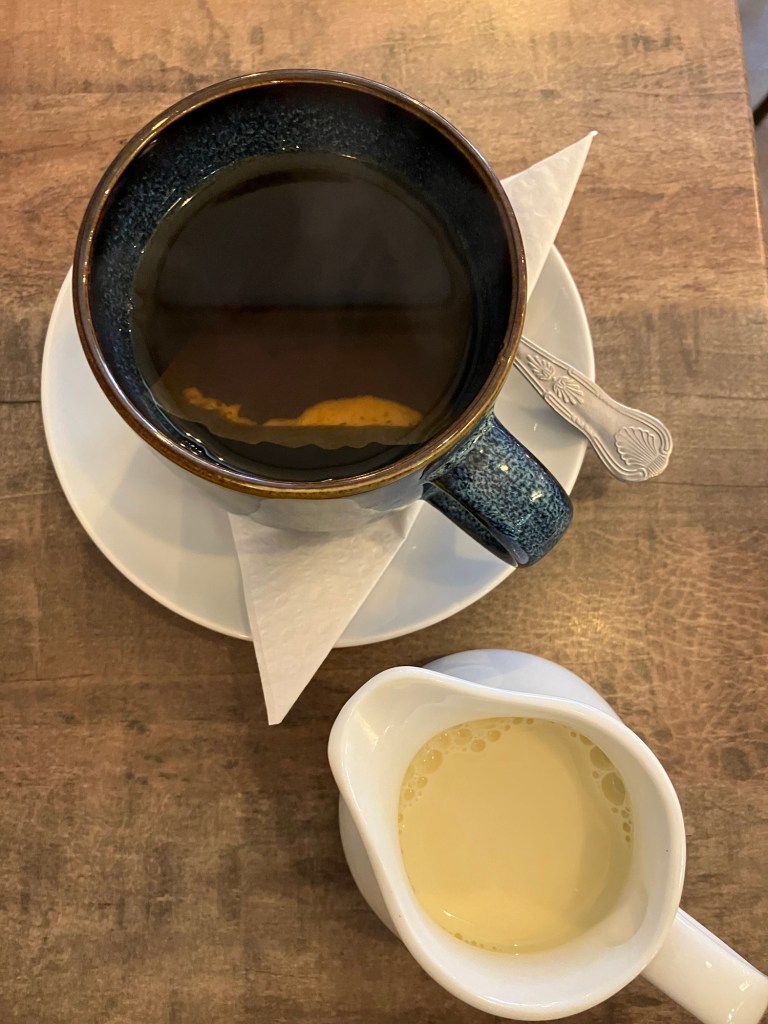
My tea arrives in a lovely big round mug, with the bag steeping nicely and a spoon on the side, plus a very generous jug of oat milk. There’s no tag on the bag, but the brew looks rich and promising. I’m not blown away, but the tea is warm and satisfying, and the cup is delightful to hold.

It’s a lovely place to sit, and a pleasant place to work – it looks like quite a few locals have clocked that. There’s also a luscious looking menu as well as the cakes, and the lunch crowd are starting to trickle in. I might pop back later on, with my laptop. 

Graveney & Meadow tea – twenty out of ten for tea

Graveney & Meadow hasn’t been open for long this morning, but it already seems to have woken up. It’s dark inside, and it isn’t brightened by the retro décor or the fairy lights that hang from the ceiling. People are wheeling in buggies with toddlers trotting along beside them or wide-eyed babies, goggling at new surroundings, clutched on one hip. Snatches of squeeze box drift out of the corner where the buggies are lined up, drawing commentary. Toddler requests for lunch are declined, but plates stacked high with muffins and hash browns, with fluffy parmesan on top, are making me hungry too.

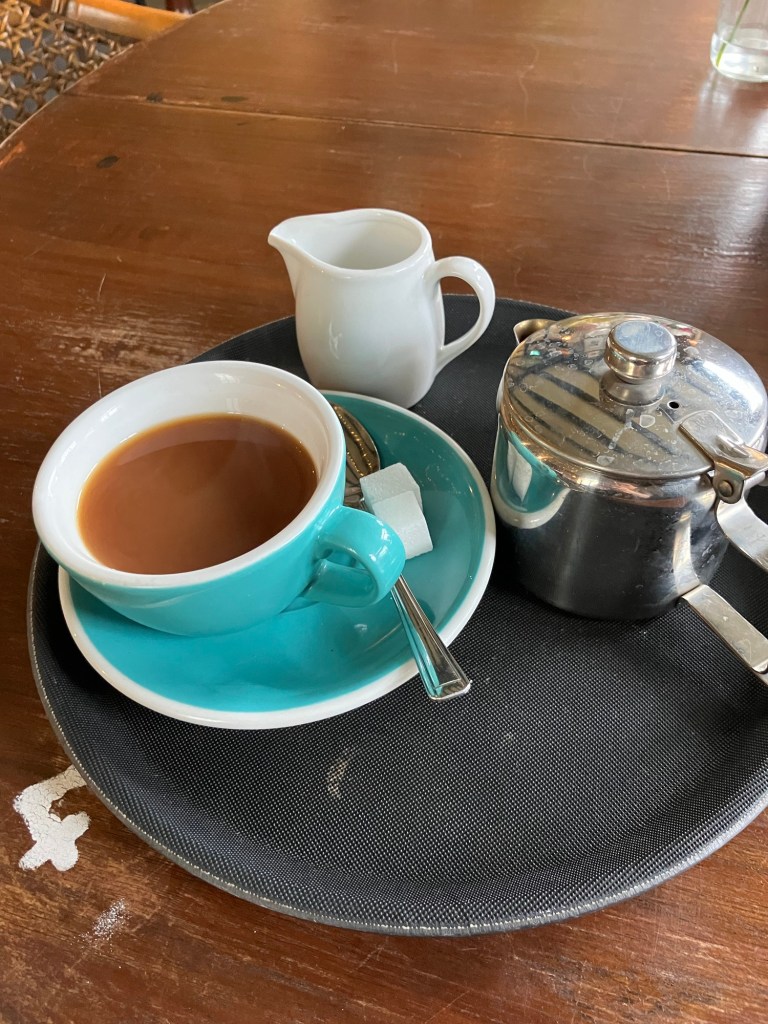
The bar man explains that he needs to take some food to people, so he’ll bring my tea over. I don’t mind waiting – my chair is really comfortable. Actually, all the chairs here look like they’d be good for extended sitting. It’s a nice change from the move-on-quickly-please hard chairs in so many places. The tea arrives shortly afterwards, neatly laid out on a tray. The cup is nice and thick, the oat milk is slightly frothy, and the teapot is of the metal, Tardis variety1 – so what looks like a one-cup serving should comfortably yield two full cups, hopefully without scalding the hands. 

Some excellent tea

It’s bag tea, without an identifying tag. I’ve left it to brew for a while, so when I pour it out – successfully, it’s not a true Tardis pot – it’s nice and thick. It’s a solid brew, with plenty of body, richly malty and slightly astringent. And it’s perfect. Twenty out of ten. I bet that’s why all the parents are here – it takes a brew of that stature to get the show on the road again after an exhausting morning of fielding toddlers.

I can just about hear gently ambient music above clattering cutlery and bubbling conversation, then the squeeze box kicks in again, this time with singing, plus the bar man banging coffee out of the machine’s filter. A doddering toddler keeps wandering to the main door and trying to push it. It’s too heavy to give access to the street, but nearly all the clientele look up every time there’s an attempt, just to make sure. 

Watching all this, I’ve managed to spill tea down my second favourite scarf. Although it makes me fit in nicely with most of the other people here, I’m going to head home and sort it out. Back for more twenty-out-of-ten tea soon. 

  1. Ben Elton’s The Man From Auntie, at 2:32, though it’s really worth watching the whole thing – it has aged very well. ↩︎

Night Riviera

I feel as if I’m on a ferry, not a train. The head end of my bed seems to roll backwards every so often as the train lurches round bends.

When the knock at the door comes, The Wife is already up and ready to retrieve the morning dose of the Sacred Liquid. Getting hold of it means navigating the suitcase that wouldn’t fit under the bottom bunk and which now takes up the entire tiny floorspace, then retrieving the tray from the steward while stopping the door from slamming the tray back into the corridor.

It doesn’t look promising. There are two paper cups of hot water, two plastic-wrapped pastries and two packets of biscuits, plus tea paraphernalia including bags in sachets, sugar, milk and those long wooden stirrers that pierce the bag and result in gritty tea, if you’re not extremely careful. I had banked on being given generic non-dairy milk in one of the plastic pots with the foil lids that contain very little liquid, but which can project their contents a surprising distance. Instead, there are sachets of actual milk.

While I hum and ha about whether to have black tea or add the milk, The Wife brews hers up. The bag is in a foil sachet with a Union Jack. ‘Tregothnan’, it says. ‘THE TEA GROWN IN ENGLAND.’ I’m hesitant, but The Wife has already got stuck into hers, and reports that it’s great.

‘I like the packaging,’ she says. ‘Bold and memorable. Very excellent colour very quickly, the water temperature was spot on, though I could have done with a bit more water in there because I could have done with a bigger tea in a bigger cup. I feel like a bigger cup would have done more justice to the tea bag because I felt like I could only dip the tea bag before taking it out. It was a quality teabag that had strength. I was happy with one milk sachet. Usually I only use a quarter of a sachet because the tea’s so weak. I liked that it came on a tray, it was a little moment of Agatha Christie.’ It went down far too quickly, she laments, and she could have done with another three or four cups.

I score a sip of hers to decide on the milk question. She’s right – it’s excellent, and she makes me an identical one. The paper cup is much better than a plastic one; I have no idea why. The Wife perches on the bottom bunk, bent awkwardly and without sufficient headroom to sit up and enjoy the ambrosial brew, while I sit back on the top bunk with my cup, watching the scenery, braving cold blasts of air conditioning and trying not to spill any when the train pitches and rolls. Like The Wife’s tea, mine is over too soon and we return the tray to the steward with grateful compliments, because this lovely welcoming drink was far more than we expected.

We and our awkward luggage stumble down the corridor, on to the platform and into the lounge, where there is more of the same and the quantity deficit is repaired. We are ready to do the day.